ZIBS
Innovation Strategies for Hidden Champions, Management Perception and Strategic Decision-Making
Book Chapter
Innovating for the Poor: The Inclusive Innovation System in China
7.2
675–695
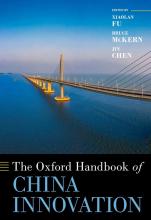
The Oxford Handbook of China Innovation
Xiaolan Fu, Bruce McKern, Jin Chen
Oxford University Press
9780190900533
https://doi.org/10.1093/oxfordhb/9780190900533.013.38
International Campus Library-Special Collection
F124/LO1/SC2
000000335956
iResearch
The Oxford Handbook of China Innovation provides a contemporary and authoritative view of the role of innovation in China’s extraordinary emergence. The Handbook consists of chapters written by over sixty experts from universities and research institutions worldwide, who describe and analyze this phenomenon with criticism, discussion of policy issues, and views about further development. It focuses on the microeconomic factors in China’s growth, of which the critical force has been the steady drive for innovation. It identifies the many factors instrumental in the development of innovation and evaluates those that are specific to China’s context, and those applicable to other nations. The scope of topics is comprehensive, covering China's development policies, the place of innovation in national priorities, the components of the national innovation system, and the resources required for their effective deployment. These include the institutions and policies that provide incentives and support to technological development, including people, financial mechanisms, private ownership, rule of law, and culture. The issue of foreign influence is also addressed, including the evolution of policy toward inward foreign direct investment and knowledge transfer and China’s goals for outward foreign direct investment. The chapters include discussion of the capabilities and strategies of world-class Chinese innovators, together with emerging issues such as environmental remediation, green energy, digital innovation, open innovation, mass innovation, and China’s future science and technology policy. As China emerges as a contender for global leadership in many fields, this Handbook provides a foundation for informed conjecture regarding the challenges ahead.